Treatment Guide · Atlanta, GA

Tennis elbow treatment that actually works

Most cases of lateral epicondylitis resolve without surgery — but only with the right treatment at the right time. This guide walks you through your options and connects you with Atlanta specialists who treat it every day.

95%
of cases resolve
without surgery
6–12mo
typical untreated
duration
faster recovery with
early specialist care

Treatment Pathway

How tennis elbow is treated

Treatment follows a logical progression from conservative to interventional. Most patients improve significantly at step one or two. The key is starting early and with the right guidance.

1
First line · Weeks 1–6
Rest, activity modification, and bracing
The foundation of tennis elbow recovery is removing the repetitive stress that caused it. A counterforce brace reduces load on the tendon during daily activities. Combined with targeted stretching and ergonomic adjustments, many mild cases resolve here entirely.
Counterforce brace Activity modification Ice therapy NSAIDs
2
Second line · Weeks 4–12
Physical therapy and eccentric exercise
Supervised physical therapy addresses the underlying muscle imbalances and tendon weakness that make tennis elbow recur. Eccentric strengthening — controlled lengthening of the extensor muscles under load — has the strongest evidence base of any conservative treatment. A sports medicine specialist can guide this precisely.
Eccentric strengthening Manual therapy Ultrasound-guided assessment
3
Third line · Months 2–4
Corticosteroid injections
When pain is severe enough to limit participation in physical therapy, a corticosteroid injection provides short-term relief that allows rehabilitation to continue. Ultrasound-guided injection ensures precision. Note: steroids provide pain relief but don't heal the tendon — they're a bridge, not a cure.
Ultrasound-guided injection Corticosteroid Short-term pain relief
4
Fourth line · Months 3–6
Platelet-rich plasma (PRP) therapy
PRP uses a concentration of your own platelets — rich in growth factors — injected directly into the damaged tendon to stimulate genuine tissue repair. It has shown strong results for chronic lateral epicondylitis that hasn't responded to conventional care. Several Atlanta specialists offer ultrasound-guided PRP as an office procedure.
PRP injection Regenerative medicine Tendon repair Prolotherapy
5
Fifth line · 6+ months of failed conservative care
Minimally invasive procedure or surgery
Fewer than 5% of tennis elbow cases reach this stage. Options include percutaneous needle tenotomy (breaking up degenerative tissue with a needle under ultrasound guidance), or open/arthroscopic surgical release of the common extensor tendon. Recovery is 3–6 months. Outcomes are generally excellent when conservative care has genuinely been exhausted first.
Needle tenotomy Tendon release Arthroscopic surgery

Advanced Treatment

Ultrasound-guided percutaneous tendon debridement

For chronic lateral epicondylitis that has not responded to conservative care, a minimally invasive procedure is available that physically removes the diseased tendon tissue — rather than masking symptoms with injections.

How it works

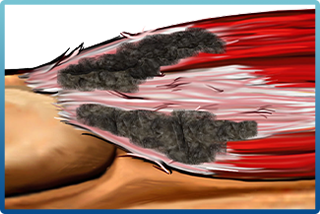
Under continuous ultrasound guidance, the treating physician makes a small incision and advances a small-gauge device directly to the degenerative portion of the common extensor tendon at the lateral epicondyle. A precise, high-pressure saline jet simultaneously breaks down and removes the damaged collagen — an integrated aspiration channel clears the debris as healthy fibers are left intact. The entire procedure typically takes 15–30 minutes in an office or clinic setting under local anesthesia.

Why it works for tennis elbow specifically

Chronic lateral epicondylitis is a tendinopathy — a degenerative condition — not a simple inflammation. Cortisone injections reduce inflammation temporarily but do not address the underlying degenerated collagen, which is why pain returns. This procedure mechanically removes that degenerative tissue at the common extensor or flexor origin, targeting the actual source of chronicity. Results are confirmed under real-time imaging.

How it compares
Cortisone injection
Reduces inflammation temporarily. Does not remove degenerative tissue. Pain typically returns within weeks to months.
Percutaneous debridement
Physically removes degenerative collagen under ultrasound guidance. Small incision, local anesthesia, office procedure. Addresses the source.
PRP therapy
Stimulates a healing response but does not remove existing diseased tissue. Complementary, not equivalent.
Surgical release
Open or arthroscopic tendon release. Effective but requires surgical center, general anesthesia, and longer recovery.
Small incision, performed in-office under local anesthesia
No general anesthesia or surgical center required
Real-time ultrasound guidance throughout
Most patients return to normal activity within days to weeks
Treats the degenerative tissue — not just the pain

Choosing Care

Which type of specialist do you need?

Two types of physicians commonly treat tennis elbow in Atlanta. The right choice depends on how long you've had symptoms and how much pain you're in.

Sports Medicine & Physical Medicine
Best starting point for most patients. These physicians specialize in non-surgical management and can supervise your entire treatment pathway from conservative care through injections and PRP.
  • Symptoms under 3–6 months
  • No prior treatment
  • Want to avoid surgery if possible
  • Need ultrasound-guided injections or PRP
  • Want a comprehensive rehabilitation plan
Interventional Pain Management
Ideal when pain is the primary issue limiting your ability to work or complete daily activities. Pain specialists offer the full range of injection therapies and regenerative options in a dedicated pain management setting.
  • Chronic pain lasting 6+ months
  • Pain limiting work or daily function
  • Prior treatments haven't worked
  • Interested in advanced regenerative therapies
  • Comorbid pain conditions

Atlanta Specialists

Physicians treating tennis elbow in Atlanta

Each physician below has an established Atlanta-area practice with expertise in lateral epicondylitis treatment. Contact their offices directly to schedule a consultation.

CG
Dr. Clay Charles Guynn, DO
Sports Medicine · Physical Medicine & Rehab
Northside Hospital Orthopedic Institute
Lawrenceville & Dacula, GA · (770) 237-3475

Fellowship-trained in sports medicine. Expert in PRP, ultrasound-guided injections, and eccentric rehabilitation protocols for elbow tendinopathy.
MS
Dr. Matthew Simmons, MD
Non-Operative Orthopedics · Sports Medicine
Northside Hospital Orthopedic Institute
Metro Atlanta, GA · (770) 237-3475

Specializes in non-operative orthopedic care. Focused on helping patients avoid surgery through precise conservative and interventional management.
KK
Dr. Kamal Kabakibou, MD
Interventional Pain Medicine
The Center for Pain Management
Atlanta, GA (Howell Mill Rd) · (404) 603-9090

Board-certified anesthesiologist with 30+ years in pain management. Fellowship-trained at Baylor. Comprehensive injection and regenerative therapy options.
EO
Dr. Efosa Ogiamien, MD
Interventional Pain Medicine
OlympusMD Pain & Wellness Specialists
Metro Atlanta, GA · (770) 676-9805

Founding partner of OlympusMD. Fellowship-trained at UAB. Advanced procedures including spinal cord stimulation, PRP, and regenerative medicine.
OH
Dr. Omar Hajmurad, MD
Interventional Pain Medicine
OlympusMD Pain & Wellness Specialists
Metro Atlanta, GA · (770) 676-9805

Board-certified, fellowship-trained at Emory University. Specializes in comprehensive pain management with a focus on patient-centered outcomes.

Get Started

Ready to start treatment?

Don't wait out the pain. Tennis elbow that goes untreated for months becomes significantly harder to resolve. Contact one of the specialists above directly to schedule your first appointment.

Contact OlympusMD Northside Providers
OlympusMD
(770) 676-9805
Dr. Kabakibou
(404) 603-9090
Northside Sports Med
(770) 237-3475